Disclaimer: This post contains affiliate links. This means I may earn a small commission if you purchase through these links, at no extra cost to you. I only recommend products I genuinely like or believe may be helpful.
There’s something strangely intimidating about a blank page.
You buy a beautiful journal, imagine filling it with deep thoughts and meaningful reflections, and then the moment you open it, nothing happens. The page stares back at you, and suddenly your mind forgets every thought you’ve ever had.
Trust me, I’ve been there.
There were times when I felt completely lost, stuck in a haze that I thought I’d never escape. Life felt heavy, not because I didn’t have people around me, but because I kept everything to myself.
For a long time, I convinced myself that staying silent was easier than opening up. Eventually, that silence became a loop, and that loop slowly pulled me into a place where no light seemed to reach. Somewhere along the way, I lost parts of myself.
That’s when I started yearning for change.
And as it often does, change began with a small habit.
For me, that habit was journaling.
I started pouring my thoughts, emotions, fears, frustrations, and everything I couldn’t say out loud onto a few simple pages. Over time, those pages became my space, a place where I could be completely honest without worrying about being judged.
In many ways, it felt like a tiny carry-home I could take anywhere.
The Truth About Journaling
One of the biggest misconceptions about journaling is that you need to know exactly what you’re going to write before you begin.
You don’t.
In fact, some of my earliest journal entries started with a simple sentence:
“I don’t know what to write today.”
And somehow, those few words often turned into entire pages.
The purpose of journaling isn’t to have all the answers before you begin. Sometimes, writing is what helps you discover those answers in the first place.
Don’t Know How To Journal? Neither Did I.
When I first started journaling, I had absolutely no idea what I was doing.
I didn’t follow a system, use prompts, or create perfectly structured entries. I simply wrote whatever came to mind.
Some pages were filled with messy lines. Others contained random thoughts, incomplete sentences, and ideas that didn’t seem to connect.
None of it was perfect.
But it was real.
And that’s exactly how journaling should be.
Make It Feel Personal
One thing I quickly learned was that I didn’t enjoy typing my thoughts into a notes app.
Instead, I preferred writing in a diary with different coloured pens, tiny stickers, little doodles, and pages that looked imperfect but felt alive.
There was something comforting about physically putting pen to paper. Watching my thoughts appear in my own handwriting made everything feel more personal and surprisingly healing.
Here are a few things I use for my journaling:
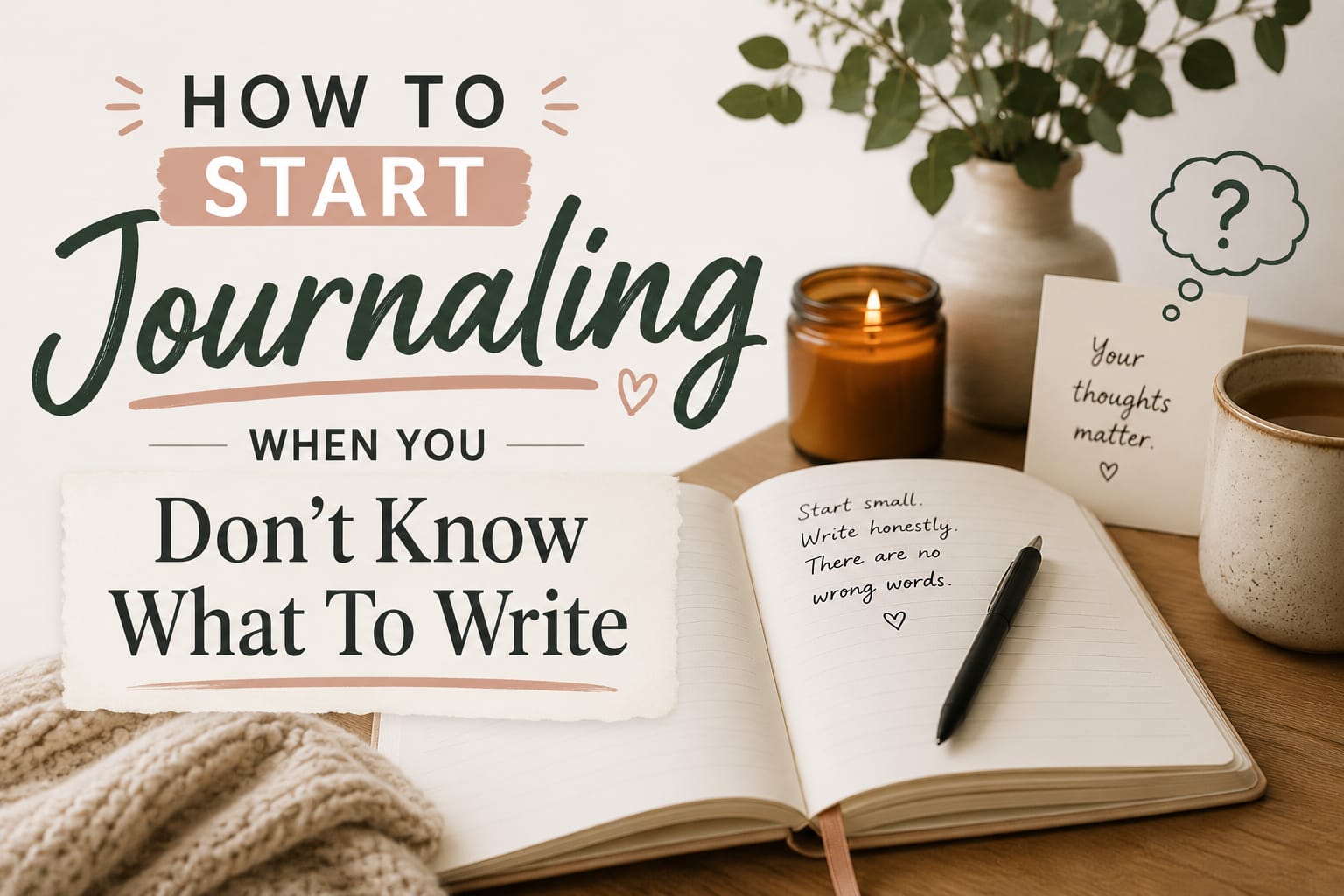
How To Start When You Have No Idea What To Write
The easiest way to begin is by keeping it simple.
Write the date. Write the time. Give yourself a nickname if you want. Then start with whatever happens to be on your mind.
You can write about:
- Something that made you smile.
- Something that annoyed you.
- A conversation you can’t stop thinking about.
- A goal you’re working towards.
- A fear you’re carrying.
- A dream you had.
- Or simply how your day went.
What you write doesn’t need to be deep, profound, or life-changing.
It simply needs to be honest.
Because honesty is what gives journaling its value.
Stop Chasing Perfection
This is probably the most important lesson I learned.
Your journal isn’t grading you. Nobody is reading it, and nobody is judging your handwriting, grammar, or spelling.
Cross things out if you need to. Write sideways. Make mistakes. Leave unfinished thoughts behind.
Your journal isn’t supposed to look perfect. It’s supposed to reflect a real human experience, and real life is rarely neat and organized.
The most beautiful journals aren’t the perfect ones.
They’re the honest ones.
Create A Journaling Ritual You’ll Actually Enjoy
If journaling feels like another chore on your to-do list, you probably won’t stick with it.
Instead, try creating a small ritual around it.
Light a candle. Make a cup of tea. Play calming music. Find a cozy corner where you can sit comfortably for a few minutes without distractions.
These little details may seem insignificant, but they can turn journaling into something you genuinely look forward to each day.
Over time, journaling starts feeling less like a habit and more like a safe place.
Over the years, I’ve found that having a few simple supplies makes journaling feel much more enjoyable. Here are some of the items I personally use and love:
Keep Going Even When It Feels Awkward
Journaling isn’t always easy.
Some days the words flow effortlessly. Other days, even a single sentence feels difficult to write.
But both kinds of days matter.
Some days you’ll write three pages without realizing it. Other days you’ll only manage three lines. Both count because progress isn’t measured by word count, it’s measured by showing up.
Keep writing.
Keep feeling.
Keep being honest with yourself.
Eventually, the words begin to flow more naturally, and one day you’ll look back at those pages and realize they quietly carried you through some of your hardest moments.
That’s the beautiful thing about journaling.
You don’t need to know what to write.
You just need to start.